
Staccato Technique for Classical Guitar
Staccato is a musical articulation that produces short, detached notes. In written music, staccato is indicated by a small dot placed directly above or below a note. Rather than allowing each note to ring freely into the next, the guitarist deliberately shortens the sound to create greater separation, clarity and rhythmic definition. On the classical guitar, staccato can dramatically change the character of a passage — adding precision, energy and contrast to the music. It is commonly used in everything from playful dance movements and Spanish repertoire to sharply articulated modern works.

Unlike many instruments where staccato is achieved primarily through breath control or bow technique, classical guitarists have several different ways of creating the effect. Because the guitar naturally produces a sustained resonance, players must actively stop the string from vibrating in order to achieve a clean and convincing staccato sound. This can be done with either the plucking hand, the fretting hand, or a combination of both.
Mastering staccato is not simply about making notes shorter. Good staccato technique requires control, timing and an awareness of unwanted sympathetic resonance from neighbouring strings. When executed well, staccato playing sounds crisp, deliberate and expressive rather than abrupt or harsh. In this lesson, we’ll explore the main methods guitarists use to play staccato, along with practical advice on when and why each approach is most effective.
Plucking Hand Staccato
It is possible to play staccato notes using just the plucking hand. For right handed guitarists, this will usually be the right hand. This is achieved by instantly placing one of the fingers back on the string immediately after the note has been played. When the finger touches the string, it will stop the note from ringing and produce a very short staccato note.
Fretting Hand Staccato – Lifting
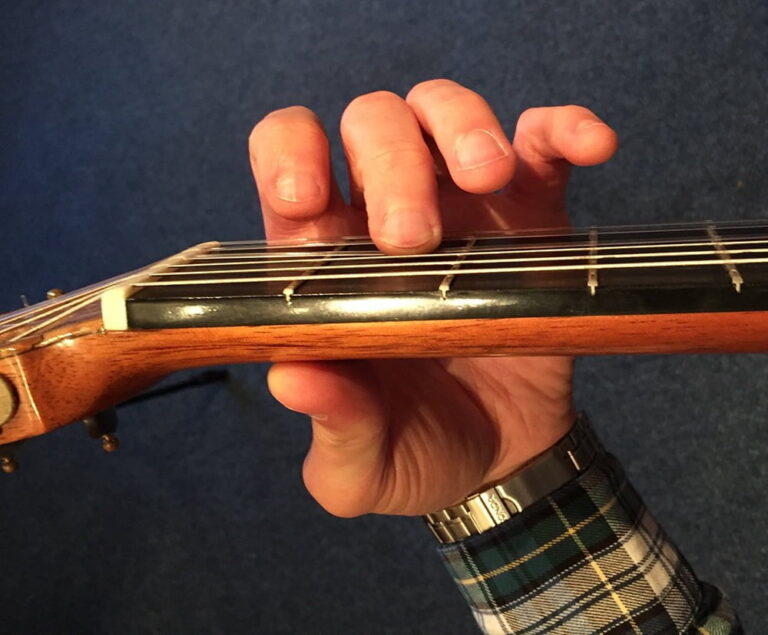
Guitarists can produce a staccato note using the fretting hand by releasing the pressure on the fretted note immediately after playing. By lifting the finger, the note ceases to ring. When using this method of staccato, it is best to keep some contact with the string whilst still releasing the pressure. In other words, lift the finger enough to stop the note, but not so much that your finger actually loses contact with the string.
Fretting Hand Staccato – Muting
The final method of staccato for guitarists is to mute the strings with the fretting hand after playing. This method involves the most effort and movement, so is not advised for fast passages of staccato notes.
To play staccato in this way, use one or more of your fretting hand fingers to touch the strings immediately after playing a note. This will kill the sound completely and produce a very clean sounding staccato note. Be careful not to slap down on the frets because this will produce an unwanted sound.
Combining Staccato Techniques
There are limitations to using a single method of staccato. For example, when using plucking hand staccato and changing from a higher string to a lower string, it is sometimes difficult to stop the higher string from ringing whilst simultaneously preparing to play the next note of the melody. Because of this, it is not advisable to rely on this method of playing staccato on it’s own when playing long or fast passages of staccato notes.
Similarly, whilst just releasing the pressure with your fretting hand will produce a staccato note, you may notice some other sympathetic resonance from the other strings when using this method alone.
To achieve a truly clean staccato note, it is advisable to use a combination of staccato methods wherever possible. It is even possible to combine all 3 methods of playing staccato described in this lesson. This will give you a very clean staccato note.
Guitar Lessons with CGA
If you’re enjoyed this please feel free to check out the other articles on our website for more hints and tips.
If you feel you’d benefit from a more in depth examination of your playing why not take lessons with Classical Guitar Academy? All pupils receive a highly customised programme of study designed to target specific issues they are encountering in their playing.
Book your lesson today!





Very good and clearly described! I myself uses all methods, singel or in combination depending on what musical effect I strive for. So, my advice is to think that music is the aim and technic is the mean. Think music first and then choose articulation technic. Don´t forget it is music you want to create.
Thank you Rolf. You make a great point about the music coming first. A guitarist’s technique is always just a vehicle for playing musically.
Thank you for this, Ed. The descriptions are excellent, concise and useful. I will put these in my “notebook”.
Thanks Dr Argondizza. It’s good to hear from you after all this time! I hope things are going well for you up in Scotland.
It is interesting, actually. “Staccato” literally means separated or divided. So perhaps in addition to, or maybe even instead of, positing that to play staccato is to play short notes, one would do well to note that staccato implies a space between the notes. This information may be particularly useful in slower tempos.
Also, in addition to being careful not to allow sympathetic resonance when lifting the left hand—if that’s the hand with which staccato articulation is being executed—one must pay attention to harmonics. For example, attempting a left-hand staccato at frets five, seven, or twelve, where the natural harmonics are especially potent, may produce an unwanted harmonic.
Thanks for your comment. I’ll consider editing the article to mention that the duration of the note does not change, but the amount of time it ‘rings’ for on the guitar does change (becomes shorter). I think this might help to make it clearer for those with no prior knowledge of staccato as it applies to music.
You make a good point about the sympathetic resonance. To achieve very clear notes it is important to utilise 2 or 3 methods of playing staccato, as suggested in this lesson. It is also possible to hear sympathetic resonance when playing other notes besides those found on frets 5, 7 and 12, so care must be taken at all times.